
I'm Ayman. I run Ayman Results, a small SEO agency in Western Sydney, and a big part of my week is spent inside other people's Google Business Profiles. Plumbers, flooring companies, pressure cleaners, mould removal. Different trades, same problem: they're good at the work, and Google Maps sends the calls to someone else.
The map is where local customers make up their minds. Someone types "plumber near me", the map appears near the top of the page, and the three businesses in it get looked at first. If you're number seven, you're on a list most people never open.
This guide is the process we follow to get businesses into that top 3. It's the same 9 steps we used for Design Timber Flooring, a Sydney timber flooring company that now ranks in the top 3 for "timber flooring contractors". I'll explain what each step is, why it matters, and give you a couple of things you can do this week. I won't hand over every checklist, tool and template we use, because that's what our clients pay for. There's still more than enough here to move you up.
The short version
- Google ranks local results on relevance, distance and prominence. You can't move your address, so you work on the other two.
- Your Google Business Profile does the most work: the right category, every service, every field filled in.
- Your website has to back the profile up: matching details, a strong title tag, and a page for every service and area.
- Citations, weekly photos and a steady stream of real reviews build prominence over time.
- Expect about 12 weeks of steady work, not one clever trick.
How Google picks the top 3
Google says local results are based mainly on three things: relevance, distance and prominence. Relevance is how well your profile matches what someone searched. Distance is how far you are from the person searching, or from the place they typed. Prominence is how well known and trusted your business is, judged from reviews, links, listings and mentions around the web.
You can't change distance. Your shop or your home base is where it is. That's why the business down the road can beat you in one suburb and disappear two suburbs over. What you can change is relevance and prominence, and every step below pushes one or both of them.
You can't move your address. You can give Google more reasons to show you anyway.
Step 1Find out where you actually rank
Searching your own keyword on your phone tells you almost nothing. Google shows different results from street to street, so you might be number two at your front door and nowhere five kilometres away.
The first thing we do is run a geo-grid scan. It checks your position for your main keyword from a grid of points across your area and shows it as a heatmap: strong where you're in the top 3, weak where you're invisible. It becomes the "before" we measure everything against.
Then we look at the top 10 businesses for that keyword and note how many reviews they have, how recent those reviews are, how many photos they've uploaded, which categories they use and whether their websites are any good. That tells you how big the gap is. If the top 3 have 400 reviews and you have 12, it's a longer game, and you'd rather know that now.
The last part of the benchmark is spotting fakes. In many trades I look at, there's at least one listing in the top 10 that doesn't look like a real business: a name stuffed with keywords, an address that makes no sense, no website. Write them down. We'll come back to them in step 8.
Try this week
- Search your main keyword in Google Maps from home, then ask a friend on the other side of your area to do the same and screenshot it. Compare the two.
- Make a quick table of the top 10: review count, star rating, photo count and primary category. The gaps jump out straight away.
Step 2Pick one main keyword
Your main keyword is the search you most want to own. For most local businesses it's simple: your category plus your city or main area. "Plumber Penrith". "Timber flooring contractors Sydney". "Pressure cleaning Blacktown".
Pick one, not ten. It decides your primary category, your title tag and your main heading, so everything points the same way. Your other services get found later, through your services list and service pages.
Use the words customers actually type, not the words on your business card. Trades often describe themselves differently from how people search for them. You might be an "electrical contractor", but your customer types "electrician". If you're unsure, type each version into Google, see what it suggests as you type, and check which one brings up the map.
Step 3Set up your Google Business Profile properly
This is where most of the ranking happens, and where I see the most mistakes. Almost every profile I audit is missing something basic.
Business name: your real name, nothing extra
Your name on Google should be the name on your signage, your invoices and your registration. Not "Smith Plumbing | Emergency Plumber Penrith 24/7". Stuffing keywords into the name is against Google's guidelines. Competitors can report it, and Google can suspend the profile, reviews and all. It's not worth the risk.
Categories: one primary, a few extras at most
Your primary category is one of the strongest relevance signals you have. Choose the one that matches your main keyword. Then add zero to three extra categories, and only for work that's a real part of the business.
More is not better here. Every extra category spreads your relevance thinner, and categories that overlap or drift off-topic dilute it further. A plumber who adds "Gas installation service", "Bathroom remodeler", "Water tank supplier" and "Hardware store" is telling Google he's a bit of everything. Look at what the top 10 in your area use. Most of them have one or two.
Fill in every field
Address or service area, website, phone, hours, description, opening date and attributes. Then the one most people miss: the appointment link. Point it at your contact or quote page. It gives people one more button to press straight from the map.
Services: the part nearly everyone skips
Google lets you list up to 99 services on your profile. In the trades I work with, the businesses at the top often list around 30. Most profiles I audit list a handful, or none at all.
Every service is another phrase Google can match you to. We pull every service the top 20 competitors list, narrow it down, take out duplicates and anything that doesn't apply, and confirm the final list with the owner so nothing's listed that they don't actually do. Then we write a short description, under 300 characters, for the top 20. Plain words, what the job is, where you do it.
Questions customers ask
Write down the questions you get asked on every job and answer them honestly. Google has been changing how questions and answers appear on profiles, so if yours has a Q&A section, use it. Either way, put the same questions on your website as an FAQ. You're answering the search before anyone has to pick up the phone.
This is the part most businesses get wrong, and honestly, it's usually where we come in. Not because it's hard to understand, but because doing it properly for 30 services takes days, and you've got jobs to run.
Step 4Make your website back up your profile
Google checks your profile against your website. When the two agree, it has more reason to trust both. When they don't, or there's no website at all, you're asking Google to take your word for it. Jimmy at Design Timber Flooring had more than 20 years of referrals and no website. Building one was the first thing we did for him.
Match your name, address and phone
Put your business name, address and phone number (SEOs call it NAP) in the footer of every page, written exactly as it appears on Google. Same unit number format, same phone format.
The title tag most SEOs would call wrong
Your title tag is the blue headline Google shows in search results. Most guides say keep it under 60 characters. There's a specific way we structure ours that most SEOs would call wrong: long on purpose, often well past 100 characters and sometimes close to 200. Here's one example.
Google cuts off what it displays, but in our experience it still reads the words past the cut-off, so your main services and "near me" carry weight. The first 60 or so characters still do the selling, so the front has to make sense on its own. There's more to it than the formula, like which words go where and what to do when you cover several cities, but this is the part that moves first.
Heading, map and schema
Your main heading (the H1) should be your primary category and city: "Plumber in Penrith", not "Welcome to our website". Your subheadings (H2s) should name your secondary categories and main services.
Embed your Google map on your contact page using the Share option on your profile. Then add LocalBusiness schema, a small block of code that tells Google your name, address, phone, hours and area in its own format. Paste your page into validator.schema.org to see what Google can read.
Count your pages
Type site:yourwebsite.com.au into Google. The number of results is roughly how many of your pages Google has indexed. We aim for at least 30. Most trade websites I check have fewer than 10: home, about, gallery, contact. That's very little for Google to rank.
Step 5Build a page for every service and every area
One page per service
A single "Services" page with a bullet list can't rank for 20 different searches. A page for each service can. Each one should be unique and genuinely useful: what the job involves, how long it takes, what affects the price, photos from real jobs and the questions people ask. For your main services that's usually 1,000 to 2,000 words or more. Not padding. Answers.
We build them as a hierarchy: the home page at the top, then your main category, then your core services, then everything else underneath. That structure shows Google you cover the topic properly from top to bottom. SEOs call it topical authority.
An "areas we serve" page, then a page per area
Next comes an "areas we serve" page and a page for each main suburb or area you want to win. The trick is making each one genuinely local: jobs you've done there, the kind of homes and problems common in that area, how quickly you can get there, local landmarks. Swap a suburb name into the same template 40 times and you've built 40 thin, near-identical pages that are unlikely to help.
And never use fake addresses. No virtual offices, no mate's garage, no PO box dressed up as a shop. It's against Google's rules, and it's a common way profiles get suspended.
Link your pages together
Link your service pages and area pages to each other where it actually helps the reader: from blocked drains to stormwater drains, from your Penrith page to the blocked drains page. Use natural, varied wording for the links rather than the exact keyword every time. Only add links that are useful, keep it to about 8 to 10 in the body of a page, and put them in the content, not only in the footer.
Step 6Get listed in the right places
A citation is any listing of your business name, address and phone number on another website. Citations feed prominence: the more trusted places that confirm the same details, the more confident Google can be that you're real and where you say you are.
There are thousands of directories, and most of them don't matter. This is the order we work in.
| Order | Where | Why |
|---|---|---|
| 1. The 80/20 | Bing Places, Apple Business Connect, Foursquare, Yelp | A handful of listings with most of the value. Apple and Bing run their own maps, and other apps pull from these platforms. Data Axle matters mainly in the US, so it's lower priority here. |
| 2. What ranks | Directories already in the top 20 for your keyword | If Google ranks a directory for your search, it trusts it, and your customers see it. In Sydney that's often places like hipages, Yellow Pages, Oneflare or True Local, plus niche ones like Houzz for flooring. |
| 3. Competitors | Where the top 3 are listed | If every business above you is on a site, you should be too. |
| 4. Volume | Paid citation services | Useful for reach once the important ones are done. Not before. |
Consistency matters more than volume. Ten listings with identical details beat fifty with three versions of your phone number. How we find every citation a competitor has is something I'll keep to ourselves, but here's a free tip: search a competitor's exact phone number in quotes on Google. You'll be surprised what comes up.
Step 7Post, add photos and get reviews every week
Steps 3 to 6 are mostly one-off work. Step 7 never stops. An active profile gives Google and customers fresh reasons to pick you, and an empty one quietly tells them you might not be around.
A Google post every week
One post a week is enough: a recent job, a useful tip, a seasonal reminder. Keep it short, add a real photo and link it to the matching service page.
Real photos, geotagged to the edges of your area
Real photos of real jobs, never stock. We ask our clients to send through photos from the week's jobs, and we geotag them to the suburbs on the edge of their area, where they're trying to grow. SEOs argue about how much Google reads the location data in a photo. What nobody argues about is that a steady stream of fresh job photos makes your profile look busy and helps the person comparing you with the next listing make up their mind.
A steady stream of real reviews
A review every week or two beats a burst of 30 and then nothing for a year. Ask on the day you finish, while the customer is happy, and send a direct link so it takes them a minute. If they're happy to, ask them to mention the job and the suburb. Reply to every review, good and bad. Never buy reviews or trade them for a discount: it breaks Google's rules, and fake reviews can breach Australian Consumer Law too.
The top 3 is rarely won with one big move. It's won by the business that keeps showing up every week.
Step 8Stay white hat, and report the fakes
Every shortcut that games the map, whether it's fake addresses, keyword-stuffed names or bought reviews, can be caught at any time. When Google suspends a profile, the reviews and the rankings go with it. Everything we do is white hat. It's slower to start, and it doesn't vanish overnight.
The flip side is that plenty of your competitors aren't playing fair. Remember the fake listings from step 1? You can report them. Open the listing in Google Maps and choose Suggest an edit. Only report when you're 100% sure it breaks the rules. The usual signs:
- A name stuffed with keywords, like "Best Cheap Plumber Penrith 24 Hour Emergency".
- An impossible address, like a tree surgeon inside a shopping centre.
- No website, or a website with no address anywhere on it.
- Several near-identical listings sharing one phone number.
When a fake listing above you is removed, you move up a spot without changing a thing.
Step 9Give it 12 weeks
This doesn't happen in a weekend. Here's how our first 12 weeks usually run.
- Week 1: benchmark.
- Weeks 2 and 3: Google Business Profile.
- Weeks 4 and 5: on-page basics.
- Weeks 6 to 9: content structure, service and area pages, internal links.
- Weeks 10 and 11: citations.
- Week 12: rankings overview, a fresh scan against the week 1 baseline.
Some businesses move faster. WeFlow Pressure Cleaning went from nowhere to Google's first page in about four weeks. Busier categories across bigger areas take longer. Anyone who promises the top 3 in a fortnight is guessing, or about to do something you won't like.
What this looked like for a Sydney flooring company
Jimmy runs Design Timber Flooring. He's been in the timber flooring business for over 20 years, and most of his work came through referrals. He'd been burnt by an SEO agency before: paid them, got nothing. So he had every reason not to trust the next one. He also didn't have a website.
We built the website, then ran this process: the profile, the services, the pages, the citations and the weekly work. Jimmy didn't have to give up his time beyond a conversation with us.
Today Design Timber Flooring ranks in the top 3 on Google for "timber flooring contractors" and similar searches. Of the first 100 people who clicked through from Google, 20 asked for a quote. That's 1 in 5.
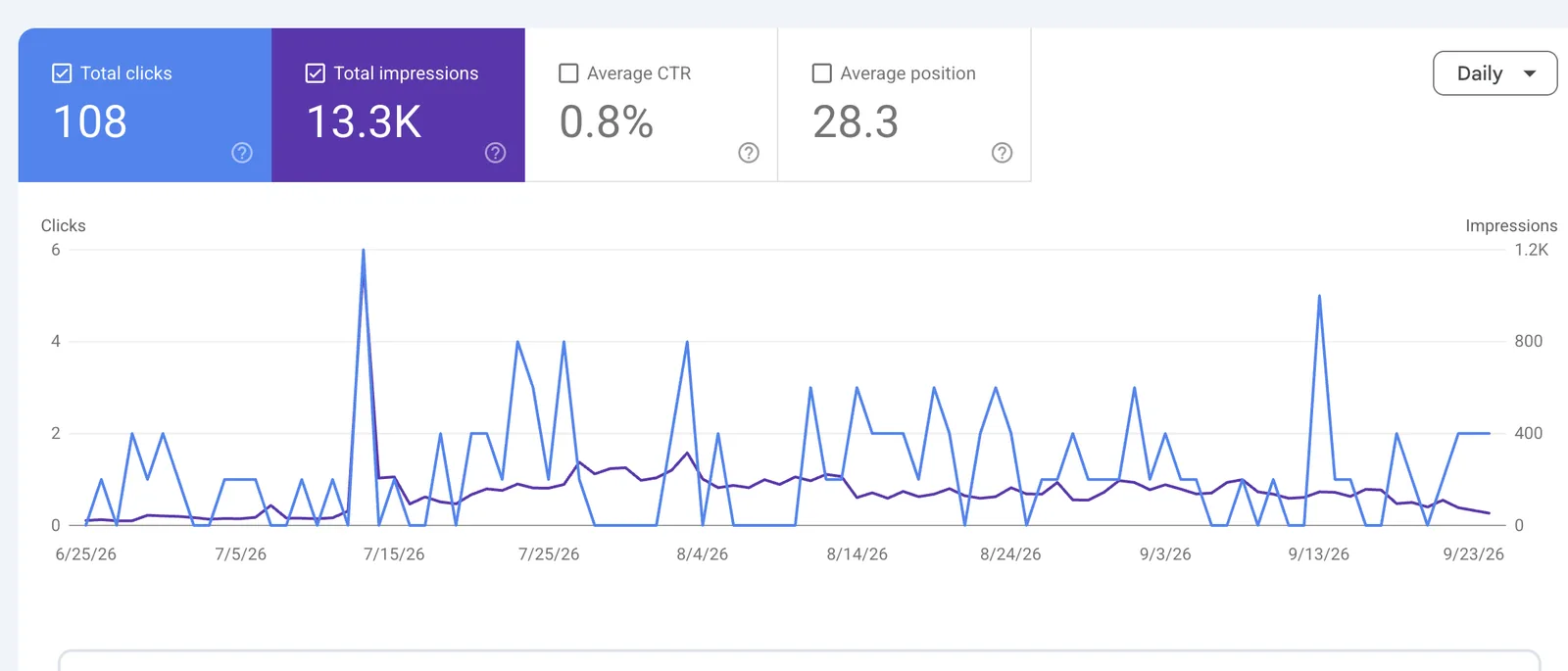
Ranking is only half the job. Once people land on your site, it has to turn them into enquiries. AAA Mould Removal got 40% more enquiries within two weeks from the traffic it already had, with no extra ad spend, just by fixing what was stopping visitors from getting in touch.
If you run a flooring business, here's how we approach SEO for flooring companies specifically.
Do it yourself, or hand it over?
Everything in this guide can be done by a business owner with time and patience. The order matters more than any single trick.
What I've left out is the detail that takes years to get right: the exact tools and settings we use for the scans, how we build and narrow the services list, the full title tag and page templates, our citation lists by trade, and the checklists we run every week. That's the work our clients hand over so they can stay on the tools.
If you're in Western Sydney, we're local, and here's how we handle SEO in Penrith and the suburbs around it. If you're a small business anywhere else in Sydney, here's how our small business SEO works. Either way, the first step is the same: find out where you stand. That's what the free review below is for.